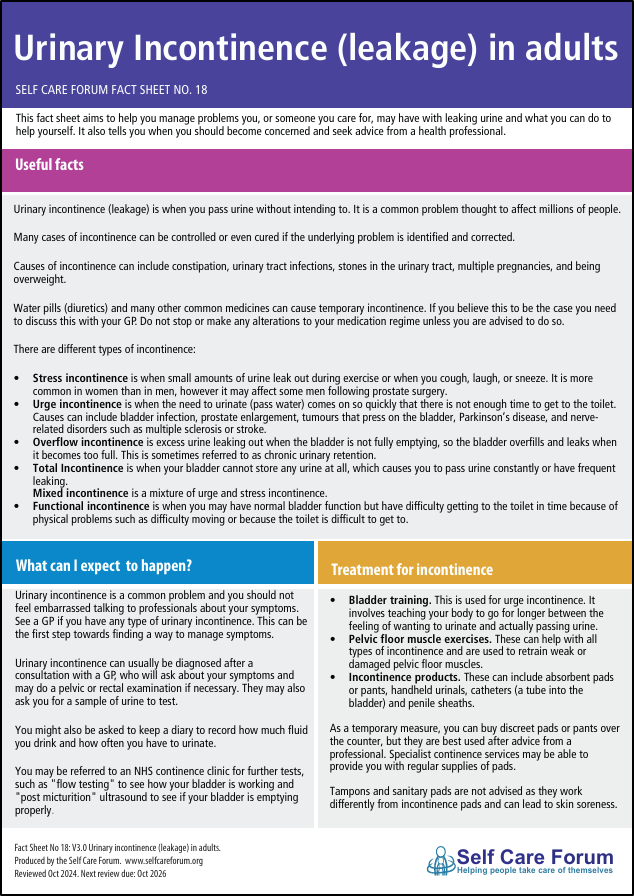
If you would like to download a copy of our urinary incontinence self-care aware fact sheet, click on the image.
This page aims to help you manage problems you or someone you care for may have with leaking urine and what you can do to help yourself.
Useful facts
Urinary incontinence (leakage) is when you pass urine without intending to. It is common and often treatable. Incontinence is not a normal part of ageing.
Many cases of incontinence can be controlled or even cured if the underlying problem is identified and corrected.
Causes of incontinence can include constipation, urinary tract infections, stones in the urinary tract, pregnancy, being overweight, prostate problems, some medicines and problems affecting the nerves or bladder.
Water pills (diuretics) and many other common medicines can cause temporary incontinence. If you believe this to be the case you need to discuss this with your GP. Do not stop or make any alterations to your medication unless you are advised to do so.
There are different types of incontinence:
Stress incontinence: leakage when you cough, laugh, sneeze or exercise.
Urge incontinence: sudden strong need to urinate and you may not reach the toilet in time.
Mixed incontinence: a mixture of urge and stress incontinence.
Overflow incontinence: the bladder does not empty properly causing urine to leak out.
Total incontinence: when your bladder cannot store any urine at all, you pass urine constantly or have frequent leaking.
Functional incontinence: difficulty getting to the toilet in time due to mobility problems or because the toilet is difficult to get to
What can I expect to happen?
Urinary incontinence is a common problem and you should not feel embarrassed talking to professionals about your symptoms.
See a GP if you have any type of urinary incontinence. This can be the first step towards finding a way to manage the problem.
Your GP will ask about symptoms, may examine you and usually test a sample of your urine. You may be asked to keep a diary of how often you drink and go to the toilet.
You may also be referred to an NHS continence clinic where further tests may be performed such as flow testing to see how your bladder is working and a scan to show if your bladder is emptying properly.
Treatment Options
Bladder training. This is used for urge incontinence. It involves teaching your body to go for longer between the feeling of wanting to urinate and actually passing urine.
Pelvic floor muscle exercises. These can help with all types of incontinence and are used to retrain weak or damaged pelvic floor muscles.
These are usually the first treatments offered.
Medicines. Some medicines can help control symptoms. Your GP will advise if these are suitable.
Other non-surgical treatments
Depending on the type of urinary incontinence you have, you may be offered other treatments. These can include electrical stimulation, which uses a mild electrical current to help strengthen the pelvic floor muscles, or biofeedback, which can help you learn how to use these muscles more effectively. Women may also be offered vaginal cones (small weights) to help strengthen the pelvic floor.
Surgery and other procedures
If other treatments have not worked or are not suitable for you, you may be referred to a specialist to discuss surgery or other procedures. Your specialist will explain the benefits and risks of the options that may be suitable for you.
What can I do to get myself better now and in the future?
See a GP if you have any type of urinary incontinence. People very often self manage their bladder problems without seeking help, assuming nothing can be done. Make use of the services and professional advice that is available by first contacting your surgery.
It is important to know that urinary incontinence, which is often difficult to talk about, is not an inevitable consequence of ageing and there is a wide choice of treatments, products and management options available to people.
You should not reduce your fluids to prevent yourself passing urine.
Lifestyle changes
There are many lifestyle changes that can help to improve bladder problems in adults. These include:
• Losing weight if overweight or obese
• Reducing caffeine and fizzy drinks
• Stopping smoking
When should I seek medical attention?
See your GP if you have any type of incontinence, particularly if it affects your quality of life in any way.
Speak to your pharmacist or GP if you think you may have a urinary tract infection (UTI).
Symptoms of a UTI can include:
• Pain or a burning sensation when you pee.
• Needing to pee more often and more urgently than usual.
• Peeing small amounts more frequently
• Cloudy urine.
Contact your surgery promptly or NHS111 (if in England or Wales, NHS24 if in Scotland or Pharmacy First if in Northern Ireland) if:
- You suddenly develop problems controlling your bladder, particularly if this is unusual for you.
- You cannot pee, or have difficulty peeing when your bladder feels full.
- Your bladder still feels full after you have peed, which may mean it is not emptying properly.
- You notice blood in your urine, even if this happens only once.
- If you have symptoms of a UTI and also develop a high or very low temperature, feel hot and shivery, have pain in your back or side just below the ribs, are vomiting, or feel very unwell. These can be signs that the infection is more serious.
Where can I find out more?
- Expert Self Care – CONfidence App (free to download and provides help and support for people with bowel and bladder leakage (incontinence))
- Bladder and Bowel UK
- Hartmann Advice Centre
- NHS website
- NHS Inform Scotland
- NI Direct, NI
- NHS111, Wales
We review our health information every two years and this information is due to be updated in October 2028.