Blog by Dr Peter Smith OBE, Self-Care Forum President
What is self-care?
The Self-Care Forum’s definition of self-care is:
The actions that individuals take for themselves, on behalf of and with others in order to develop, protect, maintain and improve their health, wellbeing or wellness.
Self-care is part of everything we do, every day, for ourselves and for others[i]. The WHO in 1986 said: ‘health is created and lived by people within the settings of their everyday life, where they learn, work, play and love’. In 1983 it said: ‘contrary to the concept of self-care as behaviour which only precedes or substitutes for professional care, self-care… is a vital component of all levels of care’ (World Health Organisation, 1983[ii]). Most self-care does not involve a healthcare professional, but as we move from being well to developing risks, symptoms and conditions, we increasingly need to turn to them for help for support, care and treatment.
The Self-Care Continuum was developed in 2004 to help both people and professionals understand this progression and to understand that there are different views on the scope of self-care, which should be approached with respect.[iii]
Since then, there has been an explosion of interest in self-care. Public access to health information, digital technologies, self-directed health interventions, consumer wellness markets, and changing attitudes to prevention have transformed the way people engage with their health and wellness.
The Self-Care Continuum continues to reflect these developments. It has been updated to help clarify terminology, strengthen alignment between public and professional perspectives, and reconfirm self-care as a cornerstone of healthy living, positive ageing and sustainable healthcare.
It reinforces the holistic nature of self-care in supporting good health while providing greater clarity about the terms we use. It recognises new forms of health engagement, including wellness as a legitimate component of self-care, prevention and healthy ageing, while acknowledging the growing importance of digital engagement, informed consumer choice and self-driven healthcare. Rather than resisting these developments, the Continuum can help health systems guide and support people in achieving longer, healthier and happier lives using the best evidence-based practice where available.
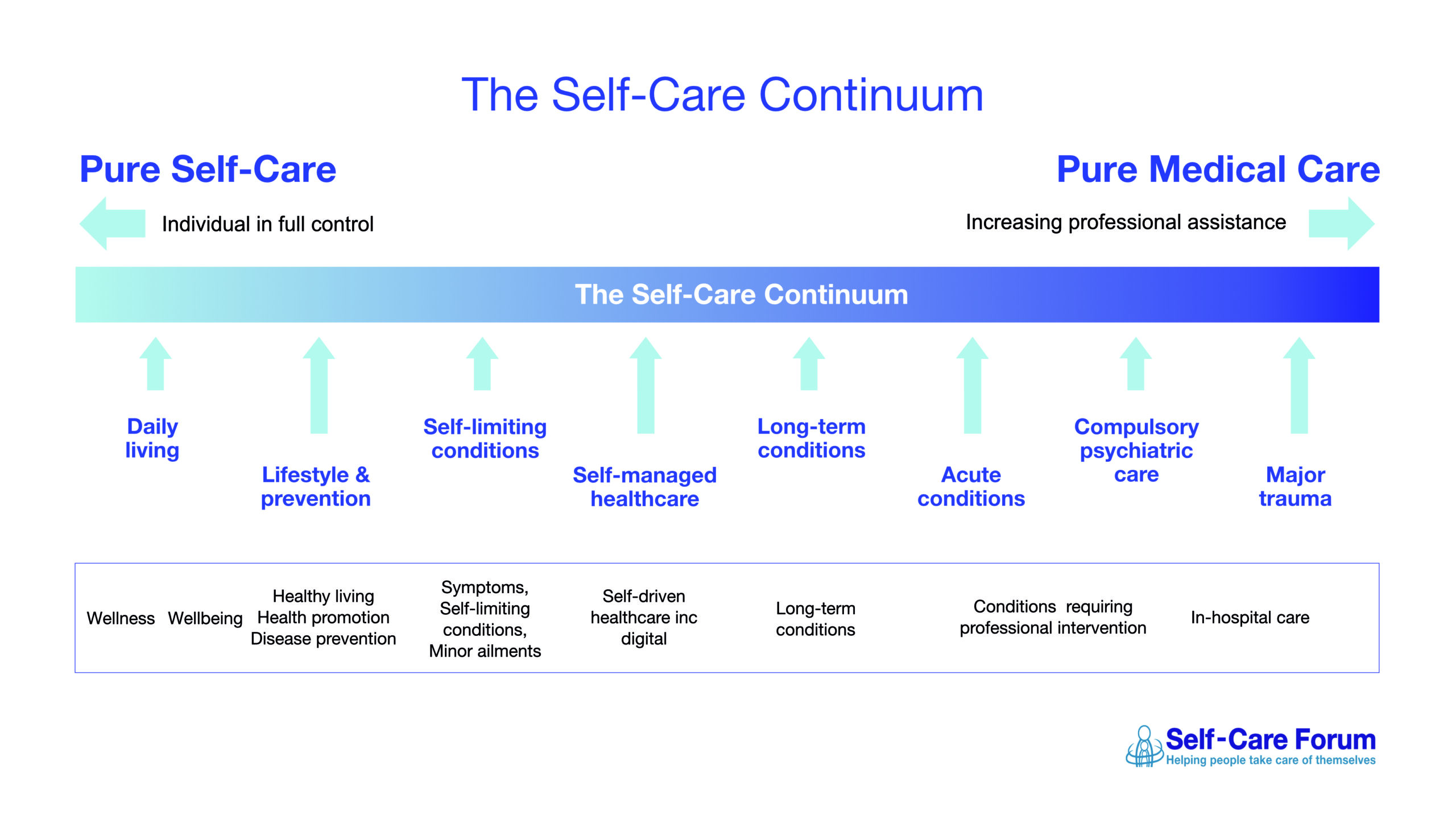
The Self-Care Continuum
As we move from left to right on the continuum, self-care remains important, but more direct help and support is required from professionals.
Self-care starts with our everyday lives where what we do is often influenced by upbringing, beliefs and contacts with other people. Wellness is about focusing on positive good health rather than on illness and disease [i]. Wellbeing is about feeling good and functioning well, helped by experiencing positive relationships, having some control over our lives and having a sense of purpose[ii].
Lifestyle is about making informed daily choices to live as healthily as possible, reducing the risk of developing diseases and of dying early [iii] by taking individual responsibility for the health, wellbeing and wellness of ourselves and of those we are responsible for. There is now a medical specialty covering it [iv]. This section includes promoting health in well people to reduce the risk of developing illnesses through activities such as brushing our teeth, using sunscreens, eating healthily, choosing to do regular exercise and connecting with others to improve our wellbeing. This may be with the assistance of a member of the wider team in primary care such as a social prescriber or a pharmacist.
Moving along the scale, most people take care of themselves and their loved ones when they have common self-limiting conditions such as sore throats, headaches, heartburn and eczema, often, for example, by using over-the-counter medicines [v] [vi]. The term ‘self-limiting conditions’ is used to separate these from the serious shorter-term conditions that require immediate treatment such as meningitis and sepsis. It is then important to know where to look for good information (such as on the Self-Care Forum [vii] and NHS websites [viii]) for the ‘red flags’ that may suggest a more serious condition.
Many self-limiting conditions can have a profound effect on our lives, which is why we do not use the term ‘minor conditions’. People then need to know how to treat their own symptoms, how long the condition may last and when and how to find help when needed. This includes help from a health professional, which may, for instance, be a pharmacist.
Real self-managed healthcare[ix] is now possible with the development of evidence-supported apps and online healthcare. Self-driven management of fitness, health and a very wide range of conditions is now possible, often through the use of ‘wearables’, supported by professionals either from written or recorded advice or through real-time online consultations.
The same is true for a limited range of named, common ‘long-term conditions’ (‘LTCs’) that are not curable but can be managed with medication and other therapies, including lifestyle changes. They require a healthcare professional at least to confirm the diagnosis and review management from time to time. Around a third of people in the UK suffer from at least one LTC, which are responsible for around 70% of the NHS’s costs[x].
People with a long-term condition can spend on average 4 hours a year with a health professional, which means the remaining 8756 (99% ) hours are spent self-managing[xi].
At the other end of the continuum are conditions that require help from a health professional, whether it be from a paramedic in an ambulance or from people with a whole range of crucial roles in a community or hospital setting. Professional support increases from acute medical and psychiatric conditions up to “major trauma” where responsibility for care is often entirely in the hands of professionals. Despite this, even in hospital there is still a need to consider the needs, beliefs and choices of the individual person. As recovery begins, increasingly independent self-care should be supported, with a move back to the left of the continuum without the individual feeling abandoned.
The NHS can support people to self-care at any point during the continuum.
Self-care is not no care.
Why is self-care good for people and the NHS?
Empowering people with the confidence and knowledge to look after themselves when they can, and access health services when they need to, gives them greater control over their lives and encourages healthy behaviours that improve wellbeing and help prevent ill health in the long-term. In short, it is the way to live a longer, healthier, happier life.
In many cases people can take care of their common conditions and manage their LTCs more effectively through self-care. Along with increasing their self-confidence this can also reduce the number of attendances at acute care facilities (such as accident and emergency departments) and GP surgery visits, enabling health professionals to focus on caring for higher risk patients, such as those with complex or multiple conditions, the very young and the elderly.
In 2002 it was recognised that full engagement of people in their own health is required to ensure the long-term sustainability of the NHS[i]. Increasing evidence-based use of self-care makes more cost-effective use of stretched NHS resources, allowing money to be spent where it’s most needed and helping to secure better health outcomes in the whole population. There are often different types of evidence supporting decisions at each stage of the continuum.
Even the fully self-caring person still requires good, reliable information based on the best available evidence, even when this is sparse. It is the responsibility of those at the right end of the continuum to provide the best advice and evidence to support individual decisions to the left of the continuum.
Tackling misinformation and disinformation
Misinformation and disinformation abound currently. Directing people towards organisations that have been awarded the PIF Tick is a good way of ensuring that people have access to reliable information. The PIF TICK is the UK’s independently‑assessed certification mark for trusted health information, run by the Patient Information Forum (PIF). It identifies organisations whose health information meets ten strict quality criteria, including evidence‑based content, user involvement, accessibility, and transparency[ii].
The NHS has also developed a tool, Unmasking Disinformation[iii], to help people make their own decisions about the reliability of information.
[i] Wanless D, for HM Treasury (2002): Securing Our Future Health: Taking A Long-Term View. Available at:
https://www.yearofcare.co.uk/wp-content/uploads/2024/07/Wanless.pdf
[ii] Getting PIF TICK Certification | Patient Information Forum
[iii] Disinformation UnMASKED